Calma: To Illustrate a Village

A young Brazilian street artist, Stephan Doitschinoff, composes spectacular murals and applies his extraordinary talent to emblazon houses, churches and walls in rural cities in his South American homeland. You can see his process, involving stencils, religious iconography, and styles referencing folk art, wood cuts, computer-generated gradients and comics.
Read More


Alphachimp @ Pop!Tech

Peter Durand from Alphachimp @ Pop!Tech from Poptech on Vimeo. Peter Durand from Alphachimp illustrates Stephen Badylak's lecture on regenerative medicine. From Pop!Tech Blogger Michelle Riggen-Ransom:

If you’re with us in Maine, you’ve probably noticed the colorful illustrations hanging on the walls of the third floor break room. If you’re not, you can take a look at them here.

These illustrations are the work of artist Peter Durand of Alphachimp Studio. Peter has set up an easel on the balcony of the Opera House, where he busily creates illustrations that capture the key elements of each presentation.

Peter let me peek over his shoulder while he illustrated a session. It happened to be Stephen Badylak’s talk on The Edge of Medicine. While images of exploded horse faces and dismembered fingers flashed on the screen, Peter managed to turn Badylak’s fascinating lecture on regenerative medicine into the illustration above. Watch a short video of his process here and see how language becomes visual art.


Storytelling and the Collective Mind

Storytelling is a human universal, and common themes appear in tales throughout history and all over the the world. These characteristics of stories, and our natural affinity toward them, reveal clues about our evolutionary history and the roots of emotion and empathy in the mind. By studying narrative’s power to influence beliefs, researchers are discovering how we analyze information and accept new ideas. More at SciAm.com

peterdurand

Peter Durand is an artist, educator & visual facilitator based in Houston, Texas.

He is the founder of Alphachimp LLC, a visual facilitation company that helps clients understand and communicate complex systems visually. He is a leader in graphic facilitation and a professor at Northwestern University Pritzker School of Law.

Rappin' about CERN's Large Hadron Collider!

I bet you were wondering when physicists would be able to discover the secret of forces behind the dark matter that holds our universe together. That is exactly the plan guiding the massive particle acceleraotor built beneath the countries of France and Switzerland. Forunately, its purpose has now been revealed to us in the lingua franca of our times: a hip-hop video!

Read More

Zen Habits: The Many Paths to Simplicity

Camden, Maine

“As you simplify your life, the laws of the universe will be simpler; solitude will not be solitude, poverty will not be poverty, nor weakness weakness.” - Henry David Thoreau

ZenHabits.net is a very personal blog by Leo Babauta. Somehow, married with six kids, this writer, runner and vegetarian models of honesty and serenity, as well as provides a trove of simplicity hacks.

Read More

Air Pirate: Arrr! The Oxymoron That Is Radio Cartooning

Mo Willems has wanted to be a radio cartoonist since he can remember. Lots of cartoonists, he said, want to make it to print publications. But inspired by New York City Mayor Fiorello LaGuardia, who read comics on the radio in the '40s, Willems wants to take his art to the airwaves.

From All Things Considered, September 4, 2008 ·

peterdurand

Peter Durand is an artist, educator & visual facilitator based in Houston, Texas.

He is the founder of Alphachimp LLC, a visual facilitation company that helps clients understand and communicate complex systems visually. He is a leader in graphic facilitation and a professor at Northwestern University Pritzker School of Law.

While a Magician Works, the Mind Does the Tricks

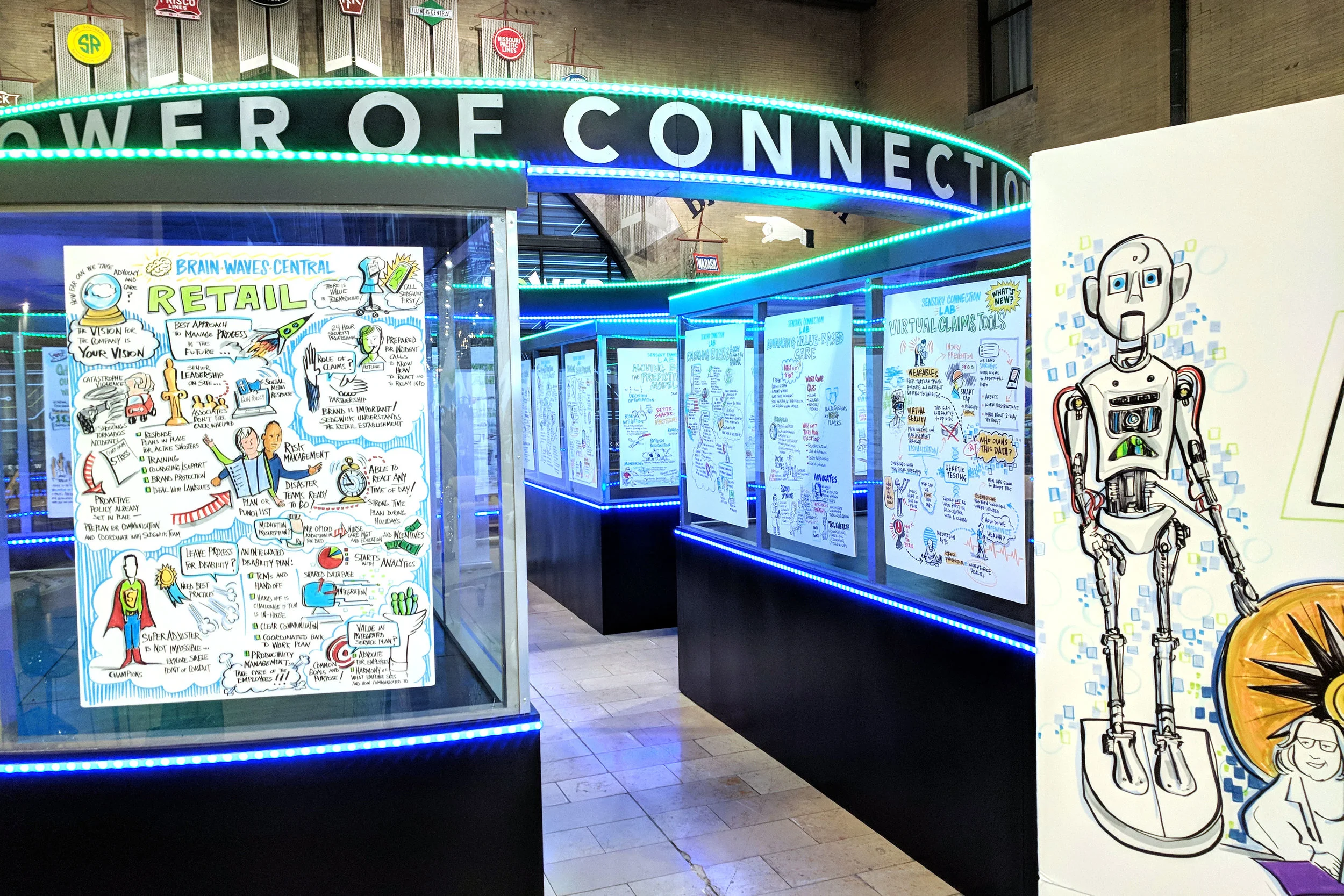
We often refer to graphic recording as a magic trick: We watch a human pull images from thin air, grabbing pictures and ideas from the vapor of conversation and giving them physical form. This NY Times article gives insight on why the physical performance of illusion is so captivating and how the brain uses neural tricks to do this: approximating, cutting corners, instantaneously and subconsciously choosing what to “see” and what to let pass.
Read More